Audiophilia
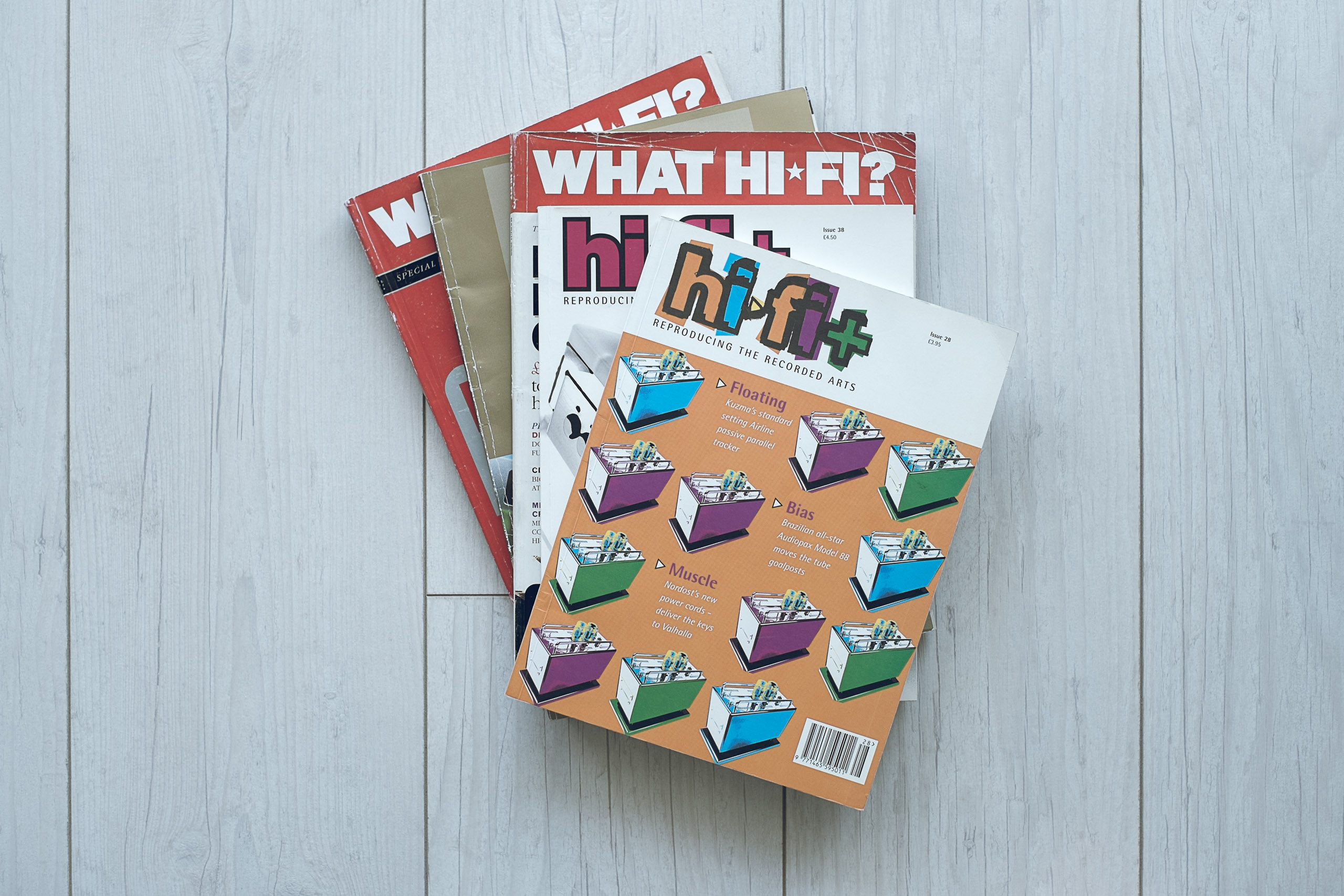
I was clearing out a box of old hi-fi magazines recently. I haven’t so much as glanced at a hi-fi rag for a good few years, so it was quite a nostalgic trip leafing through the pages. It struck me how quaint and dated turn-of-the-century hi-fi seemed:
In the last twelve months, analogue cassette tape remains the most popular and affordable recording medium.1
That’s straight from What Hi-Fi’s 1999 Awards Issue. The same article goes on to note that MiniDisc is “the format of choice for music on the move”. Ha! It’s also interesting to learn about the Panasonic NV-HD640B: a “stonker” of a VCR (Video Cassette Recorder) that “proves there’s life in the old analogue dog yet”. Of course, this was when it cost upwards five-hundred quid for a decent “DVD-Video player”, as they so awkwardly called it in ’99. I’m genuinely shocked how quickly things have changed. It makes you wonder how music will be delivered 15 years from now. My guess? In edible form, perhaps as a topping on a Domino pizza. (Okay. I took that too far.)
What stuck out most, though, was not the dated technology, but rather the clichéd, jargon-loaded and hyperbole-laden writing. It seems that advertisers and reviewers alike will do anything to distract from the facts: speakers that “soar with high notes that radiate through the acoustic and then fall as her lyrics become laden with disappointment”2 amplifiers which “hang on to the rhythm of the sound for grim death”3 pre-amp cases made of acrylic to “avoid the stray magnetic currents caused by metal casework affecting the audio signal”4 there’s no end to the absurdity. And what about this beauty…
Right from the opening violin notes the improved focus and spacial definition is obvious. The acoustic space is blacker, with a quieter background which makes the side and rear walls of that space much more apparent. The texture of the insistent notes is also more obvious, as is the sweep of the awakening orchestra as the opening bars pass across the strings, the punctuation of the percussion that much more emphatic.5
What’s it describing then? A beautiful new concert hall? Perhaps a state-of-the-art sound stage? Nope. This is describing a mains cable. Ah, but not just any mains cable. This is a two-meter, Nordost brand £900 mains cable. You see, it’s the two fat zeros after the nine in the price which makes it so good, which “makes the voice more convincing and intimate, giving the song a new focus and core”. Of course, to reap the most benefit you need one for each component in your hi-fi.
Shame on you Hi-Fi+, and shame on the article’s author and repeat offender Roy Gregory. (EDIT: Gregory stepped down as editor of Hi-Fi+ in early-2009 to become head of marketing at—you guessed it—Nordost.)
- 1What Hi-Fi. "Recorders." What Hi-Fi Awards Issue (1999), p.62 #
- 2Gregory, R. “Panel Beaters.” Hi-Fi+ no.28 (2004): p.75 #
- 3What Hi-Fi. “Amplifiers.” What Hi-Fi Guide to Audio (2000), p.59 #
- 4What Hi-Fi. “Plastic Fantastic.” What Hi-Fi (March 1999), p.97 #
- 5Gregory, R. “The Nordost Brahma Mains Lead.” Hi-Fi+ no.28 (2004): p.88 #